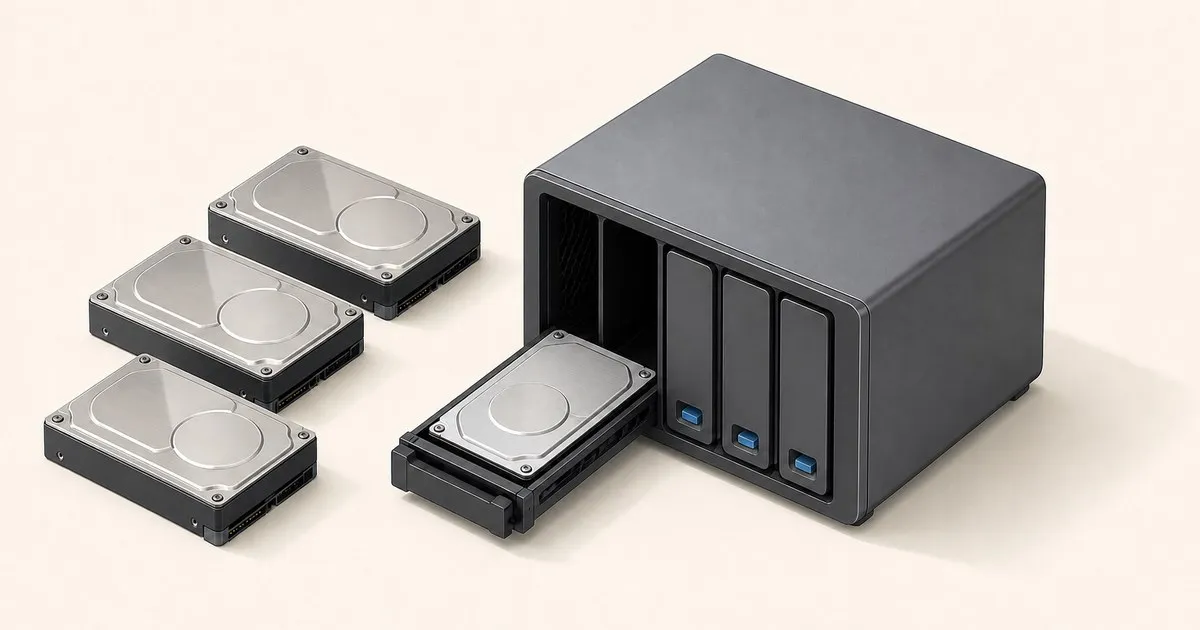
Best Hard Drives for TrueNAS NAS in 2026
The best hard drives for TrueNAS NAS must be CMR, not SMR — ZFS will punish the wrong choice. Here are the top picks by workload, budget, and bay count.
Picking the best hard drives for TrueNAS NAS is not the same as picking drives for a Synology or QNAP box. TrueNAS runs ZFS, and ZFS has one hard rule that eliminates a large chunk of the consumer NAS drive market: no SMR. Get that wrong and you will spend a weekend watching a resilver crawl for three days, or worse, lose data. Get it right and your pool will outlast the hardware around it.
This guide covers the drives the TrueNAS community and iXsystems actually recommend, the models to avoid, and how to match capacity tier to use case.
Why TrueNAS Drive Selection Is Different
ZFS manages its own redundancy. When a drive in a RAIDZ or mirror pool fails or is replaced, ZFS performs a resilver — it reads every block on the surviving drives and writes them to the replacement. That process hammers the drives with sustained sequential and random writes for hours.
CMR (Conventional Magnetic Recording) drives handle this fine. They have predictable write performance across the entire platter surface and deliver 150–250 MB/s during sustained workloads.
SMR (Shingled Magnetic Recording) drives do not. SMR layers tracks over each other to increase density, then uses a small CMR cache region as a staging buffer. Under the write loads of a resilver, that cache fills quickly and the drive throttles to a crawl — sometimes under 10 MB/s — while it reorganizes data in the background. iXsystems documents this explicitly, noting that affected WD Red SMR drives “can enter a faulty state under heavy write loads” and return errors that cause vdev degradation or data loss.
The TrueNAS Hardware Guide is direct: Host-Managed SMR drives are unsupported, and Drive-Managed SMR drives cause “degraded write performance and longer, less reliable resilver operations.” Treat this as an absolute constraint, not a preference.
TrueNAS NAS drives compared
Every drive below is CMR, which is the only non-negotiable. What separates them is workload rating, warranty length, and the bay count the manufacturer designed the vibration handling around. Specifications are from the manufacturers’ published datasheets.
| Drive | Recording | RPM | Workload rating | Warranty | Rated bays | Best for |
|---|---|---|---|---|---|---|
| Seagate IronWolf Pro | CMR | 7200 | 550 TB/yr | 5 years | Unlimited | The default choice for a 24/7 pool |
| Seagate IronWolf | CMR | 5400–7200 | 180 TB/yr | 3 years | 1–8 | Home pools with light write loads |
| WD Red Plus | CMR | 5400–7200 | 180 TB/yr | 3 years | Up to 8 | Home builds up to eight bays |
| WD Red Pro | CMR | 7200 | 550 TB/yr | 5 years | Unlimited | Larger or busier pools |
| Seagate Exos X | CMR | 7200 | 550 TB/yr | 5 years | Enterprise | High capacity, if noise is acceptable |
| Toshiba N300 | CMR | 7200 | 180 TB/yr | 3 years | Up to 8 | Price-driven alternative |
| WD Red (non-Plus, under 8 TB) | SMR | 5400 | — | 3 years | — | Not for ZFS. Avoid. |
Two columns do most of the work. Workload rating is the terabytes written per year the manufacturer warrants; a home pool rarely approaches even the 180 TB/yr of the non-Pro tiers, so the jump to 550 TB/yr usually buys warranty length and vibration tolerance rather than headroom you will actually use. Rated bays is the other half of that: the 180 TB/yr drives are specified for 1–8 bay enclosures, while Seagate and WD both state no bay limit on their Pro lines, which is what matters once six or more drives share a chassis and vibrate against each other.
The Best Hard Drives for TrueNAS NAS
Seagate IronWolf Pro — Best All-Around
The IronWolf Pro is the consensus pick for TrueNAS builds that run 24/7. Per Seagate’s datasheet: 7200 RPM, max sustained transfer up to 285 MB/s on the largest capacities, a 550 TB/year workload rate limit (versus 180 TB/year on the standard IronWolf), unlimited drive bays supported, and a 5-year limited warranty with three years of Rescue Data Recovery Services included. The rotational vibration (RV) sensors matter in multi-bay enclosures where drives vibrate against each other — the IronWolf Pro compensates in firmware.
The line now runs up to 32 TB. For new builds the 12 TB and 16 TB tiers usually sit near the best price-per-terabyte on the Pro line, though that moves with street pricing and is worth checking rather than assuming. The 5-year warranty also reduces the risk calculus on high-capacity drives where a replacement is expensive.
Seagate IronWolf — Home and Light Prosumer
The standard IronWolf shares the same CMR design and AgileArray firmware as the Pro, drops to a 3-year warranty and 180 TB/year workload rating, and runs at 5400 RPM at lower capacity tiers (7200 RPM at 8 TB and above). For a home NAS with light-to-moderate write loads — media streaming, backups, personal files — the standard IronWolf is often the right call, especially when the Pro carries a significant price premium.
Available 4 TB to 16 TB. The 8 TB tier is a common sweet spot for home RAIDZ2 builds.
WD Red Plus — Home NAS, Up to 8 Bays
WD Red Plus is the safe WD choice for home TrueNAS deployments. It uses CMR, targets 1–8 bay enclosures, carries a 3-year warranty, and is priced competitively against the IronWolf. The drives run 5400 RPM at lower capacities and 7200 RPM at 8 TB and above.
One critical note: WD Red (without “Plus” or “Pro”) uses SMR in capacities under 8 TB. The TrueNAS community has documented that moderators explicitly warn against these drives — look for the “Plus” or “Pro” designation and confirm the product code does not contain “EFAX,” which indicates an SMR model.
WD Red Pro — Larger and Busier Pools
WD’s datasheet specifies Red Pro for “RAID-optimized NAS systems with unlimited # of bays”, 7200 RPM across all capacities, a 550 TB/year workload rate, up to 2.5M hours MTBF, and a 5-year limited warranty. Available from 2 TB to 26 TB. Spec for spec it is the direct counterpart of the IronWolf Pro — same workload rate, same warranty, same absence of a bay limit — so choose on price at the capacity you need.
Seagate Exos X — High-Capacity and Enterprise Builds
For TrueNAS builders maxing out capacity — think 10+ drives at 16 TB or 20 TB each — the Seagate Exos X series is worth considering. These are enterprise nearline SATA/SAS drives designed for data center use: 5-year warranty, enterprise error recovery firmware, and 550 TB/year workload ratings. They regularly appear on sale at prices that beat the IronWolf Pro per terabyte at high capacities.
The tradeoff is noise and heat. Exos drives run hotter than NAS-tuned consumer lines and are louder; in an open rack this is fine, in a home office it is noticeable.
Toshiba N300 — Solid Alternative
The Toshiba N300 is a CMR NAS drive rated by Toshiba for up to 180 TB/year, up to 8 drive bays, 7200 RPM, and a 3-year limited warranty. It sees less community discussion than the Seagate and WD lines but is a legitimate option if pricing is favorable. Available up to 22 TB.
What to Avoid
- WD Red (non-Plus, non-Pro) under 8 TB: SMR, documented incompatibility with ZFS, avoid entirely.
- Desktop drives (WD Blue, Seagate Barracuda, etc.): Consumer error recovery timers are set aggressively to avoid stalling a single-disk OS. ZFS needs longer error recovery windows; desktop drives will report errors to the controller before ZFS has a chance to recover, causing unnecessary pool degradation.
- SMR drives from any vendor: The issue is the recording technology, not the brand. Check the manufacturer’s product specification sheet or use a known-good CMR database before purchasing any drive not on the lists above.
Capacity and Configuration Notes
The TrueNAS Hardware Guide suggests preferring multiple smaller drives over fewer large drives for better write parallelism and more flexible vdev configurations. That said, cost-per-terabyte often favors larger drives at the 12–16 TB tier. A practical starting point for a home build: six 8 TB CMR drives in RAIDZ2 yields roughly 32 TB usable with two-drive fault tolerance. For a heavier workload or expansion-focused build, eight 12–16 TB drives in RAIDZ2 or two RAIDZ1 vdevs gives more headroom.
Drive count and pool topology are one decision, not two: the same six drives yield very different usable capacity as RAIDZ1, RAIDZ2, or mirrors. Work the tradeoff through ZFS pool design: RAIDZ vs mirrors, then check the resulting number in the ZFS pool capacity calculator, which accounts for parity, padding, the slop reserve, and the ~80% fill ceiling. If the rest of the machine is not settled yet, the TrueNAS hardware requirements guide covers the CPU, memory, and controller side, and TrueNAS pool expansion options covers how you will grow this pool later.
Whatever capacity you choose, the backup rule does not change. RAIDZ protects against drive failure, not against accidental deletion, ransomware, or controller failure. The 3-2-1 backup model — three copies, two media types, one offsite — applies regardless of how good your pool is.
Related across the network
- Sizing NAS Hardware: Bays, HBAs, ECC Memory and Power — nashardwareguide.com
- NAS Buying Guide: How to Choose Your First NAS — nashardwareguide.com
Sources
- TrueNAS Hardware Guide — iXsystems
- WD SMR Drive Compatibility Notice — TrueNAS Documentation
- Seagate IronWolf NAS Hard Drives — Seagate
- Seagate IronWolf Pro Datasheet (DS2129) — Seagate
- WD Red Pro NAS Hard Drive Data Sheet — Western Digital
- WD Red Plus Data Sheet — Western Digital
- Toshiba N300 NAS Hard Drive — Toshiba Storage
- Best Hard Drives for NAS Devices — WunderTech
Related

TrueNAS RAM Requirements by Workload
TrueNAS RAM sizing for file sharing, apps, VMs, iSCSI, directory services, L2ARC, and deduplication, based on official workload guidance.

Best Budget NAS Build for Home: What Actually Works in 2026
A practical guide to the best budget NAS build for home use: Intel N100 platforms, ZFS-compatible drives, TrueNAS SCALE setup, and the backup plan.

How to Migrate from TrueNAS CORE to SCALE Safely
Migrate TrueNAS CORE to SCALE with verified backups, the supported upgrade path, configuration restore, and checks for encryption, shares, and apps.